
帰り道
The Road Home
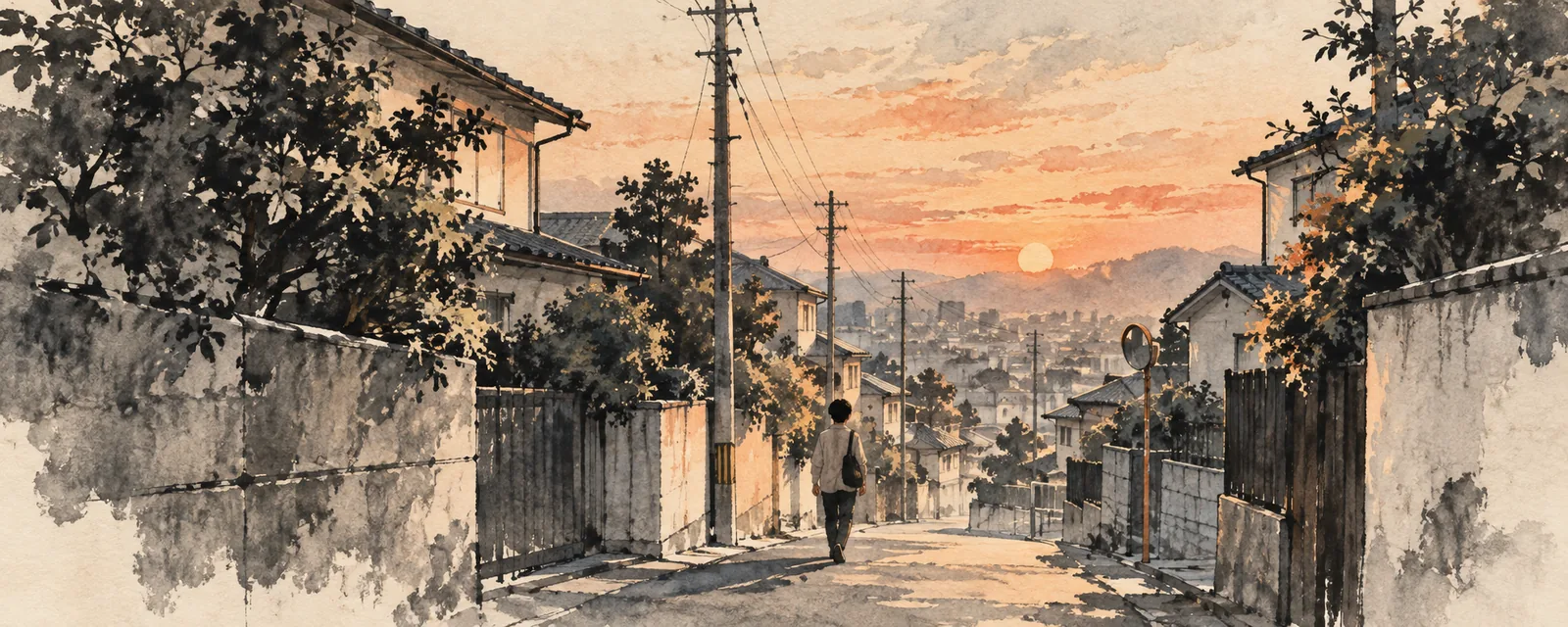
Read by a synthetic voice and checked by a person.
Display
VocabularyGrammar
Showing the words and patterns this article teaches, plus anything at or above its level. Every other word is still tappable.
、。
Study this paragraph
同じ道を / もう十年 / 歩いている
- 同じ
- Modifies the noun directly with no な: 同じ道 = the same road. 同じな道 is wrong.
- をpath particle
- With a motion verb を marks the space passed through, not an object being acted on. 道を歩く = walk along the road.
- もうadverb
- Here it means “already”, not “more”.
- 十年
- A duration. Japanese places it before the verb with no particle.
- 歩いている
- 歩く → 歩いて → 歩いている. ⚠️ Not “walking right now”: with a repeated action 〜ている marks a state continuing up to now — “I have been walking it for ten years (and still do).”
There is no 私 in this sentence. Japanese drops the subject when context makes it obvious; English has to put “I” back in.
I have been walking the same road for ten years now.
。、。
Study this paragraph
2 words1 grammar point1 exercise
道そのものは / 変わらない。// けれども、// 道の両側は / 少しずつ / 変わっていく。
- そのものemphatic noun
- Adds emphasis: “the road itself”, as opposed to what sits beside it.
- はtopic particle
- Marks the topic and sets up a contrast — 道そのものは implies “but something else does change”.
- 変わらない
- 変わる → 変わらない. Plain negative — the text stays in plain form, so there is no です/ます to signal politeness.
- けれどもcontrastive conjunction
- Joins two clauses in contrast: “but / however”.
- のlinking particle
- Links two nouns: 道の両側 = the two sides of the road.
- 少しずつadverb
- ずつ after a quantity gives a steady rate: “little by little”.
- 変わっていく
- 変わる + 〜ていく. The change moves away from now into the future. Its counterpart 〜てくる would bring it up to now.
Two は in one paragraph, both contrastive: each one sets its topic against something that is not being said.
- そのものそのものthe thing itself; itselfContext note
- 両側りょうがわboth sidesContext note
- 〜ていくchange (and go on changing) — a shift continuing away from now
The road itself does not change. But the two sides of it change, little by little.
Which ending expresses a change that keeps going into the future?
道の両側は少しずつ変わって( )。
、。、。、。
Study this paragraph
4 words1 grammar point1 exercise
去年まであった花屋は / 今は / コンビニになった。
- までlimit particle
- Marks the end point in time: “up until last year”.
- あった
- ある → あった. Inside a noun-modifying clause it describes a state, not a past event: “the flower shop that was there”.
- になった
- なる takes に for what something turns into: X になる = become X.
- 通った
- ⚠️ 通う (かよう), to go somewhere regularly — not 通る (とおる), to pass through. A bookshop you went to as a child is 通う.
- いつのまにかadverb
- “before you know it” — the change happened without the speaker noticing.
- 消えていた
- 消える + 〜ていた. The state was already true when he noticed it.
- たびにevery time
- Attaches to a dictionary-form verb: every time that happens, the same result follows.
- 思い出せなくなる
- 思い出す → 思い出せる (potential) → 思い出せない → 思い出せなくなる. “Become unable to recall.”
〜なくなる is a chain of three grammar points stacked on one verb. Reading it left to right — potential, then negative, then change of state — is the fastest way in.
- 花屋はなやflower shopContext note
- 通っかよっwent to regularly; commuted (通う)Context note
- いつのまにかいつのまにかbefore you know it; without noticingContext note
- 思い出せおもいだせcan recall (思い出す, potential)Context note
- 〜たびにevery time ~ happens
The flower shop that was there until last year is now a convenience store. The bookshop I used to go to as a child had vanished before I noticed. Every time a new shop opens, I become less able to remember what was there before.
Fill the blank: “every time a new shop opens”.
新しい店ができる( )に、前に何があったか思い出せなくなる。
。、。。、。
Study this paragraph
5 words1 grammar point1 exercise
毎朝 / あいさつを交わしていた老人は、// 去年の冬から / 見かけない。
- もinclusive particle
- Replaces は/が and adds “too”: the neighbours changed as well.
- 入れ替わった
- 入れ替わる, an intransitive verb — the people changed over, nobody changed them.
- 交わしていた
- 交わす + 〜ていた: a habit that used to continue. It modifies 老人 directly.
- からsource particle
- After a time expression から marks a starting point: “since last winter”.
- 見かけない
- 見かける (to catch sight of) in the plain negative. Present tense, so: “I have not been seeing him.”
- だろうかwondering
- A guess turned into a question to oneself: “I wonder if…”.
- てしまうcompletive / regret
- 足を速めてしまう — 〜てしまう marks something done without intending to.
The sentence stops at 「引っ越したのだろうか。」 and never names the other possibility. 〜てしまう then shows him turning away from it. The grammar is doing the work the words avoid.
- 入れ替わっいれかわっwere replaced; turned over (入れ替わる)Context note
- あいさつあいさつgreetingContext note
- 交わしかわしexchanged (交わす)Context note
- 老人ろうじんelderly personContext note
- 速めはやめquicken; speed up (速める)Context note
- 〜てしまうend up ~ing; ~ regrettably / unintentionally
The neighbours have turned over too. The old man I used to exchange greetings with every morning has not been seen since last winter. Did he move away, I wonder. I always end up quickening my pace right around that thought.
What does 足を速めてしまう suggest about the narrator?
、、。
Study this paragraph
1 word
角を曲がったときに / 見える空だけは、// 昔のままだ。
- それでもcontrastive conjunction
- “Even so” — concedes what came before, then pushes against it.
- 角
- ⚠️ かど here (a street corner), not かく (an angle). 角を曲がる is the fixed phrase.
- をpath particle
- Again the path-marking を: 角を曲がる = turn at the corner.
- たときに
- Plain past + とき = “when (that happened)”. に pins it to that moment.
- 見える
- Intransitive: something is visible, not “I see it”. Compare 見る.
- だけlimiting particle
- Limits what precedes: only the sky.
- のままだunchanged state
- まま = a state left untouched. 昔のまま = just as it was.
- 昔むかしthe past; long agoContext note
Even so, the patch of sky you see when you turn the corner is exactly as it always was.
、。、。、。
Study this paragraph
2 words1 grammar point1 exercise
建物の間から / 細長く見えるだけの空だが、// 季節によって / 色が変わる。
- 間
- ⚠️ あいだ here (between two things), not ま.
- からsource particle
- Marks the starting point of the line of sight: seen from between the buildings.
- だけのlimiting particle
- だけ + の turns the limitation into a modifier: “a sky that is only visible as a thin strip”.
- がsubject particle
- Between two clauses が means “but”, not the subject marker.
- によってagent / cause
- “Depending on”: the colour changes according to the season.
- 白く
- 白い → 白く. The adverbial form, used here to連結 into the next clause.
- ほどproportional particle
- ⚠️ Proportional ほど: the more tired the day, the longer he looks. Not the “approximately” ほど.
- 建物たてものbuildingContext note
- 細長くほそながくlong and narrow (細長い)Context note
- 〜ほどthe more ~, the more ~
It is only a narrow strip of sky between the buildings, but its colour changes with the season. White in summer, blue in winter. The more tired I am on the way home, the longer I end up looking at it.
「疲れて帰る日ほど、その空を長く見てしまう」— what does ほど mean here?
。、。、。
Study this paragraph
4 words1 grammar point1 exercise
アスファルトがぬれると、// 十年前と / まったく同じにおいがする。
- もinclusive particle
- “Too” — the smell is a second unchanged thing, after the sky.
- とquotation / with
- After a plain verb と means “whenever / when that happens”, describing a reliable result.
- 十年前と
- This と is “with / as”: compared with ten years ago.
- がするsensation verb
- においがする, 音がする — a fixed pattern for perceiving a smell or sound.
- というnaming / quotation
- Links a word to the noun after it: 記憶というもの = the thing called memory.
- よりcomparison particle
- Comparison: A より B のほうが〜 = B is more ~ than A.
- かもしれないepistemic modal
- A genuinely uncertain guess — weaker than だろう.
「〜のかもしれない」 with の softens it further: he is offering the thought, not asserting it.
- においにおいsmell; scentContext note
- アスファルトアスファルトasphaltContext note
- ぬれるぬれるto get wetContext note
- まったくまったくcompletely; exactlyContext note
- 〜かもしれないmay; might; perhaps
The smell of rainy days is the same too. When the asphalt gets wet, it smells exactly as it did ten years ago. When it comes to memory, perhaps the nose is more honest than the eyes.
Why is かもしれない used instead of だろう in the last sentence?
。、、。。
Study this paragraph
3 words
駅から家まで、// いつもだいたい同じ歩数で / 着く。
- 数えたことはない
- 〜たことがある/ない = have (never) done something. は here adds contrast: “I have never actually counted, but…”.
- けれどcontrastive conjunction
- “Although / but”. Slightly softer than けれども.
- からsource particle
- Paired with まで to give a range: 駅から家まで = from the station to home.
- でmeans / place particle
- Marks the means or measure: arriving in roughly the same number of steps.
- 着く
- Intransitive “to arrive”. The destination takes に, though it is omitted here.
- のだろうexplanatory + conjecture
- の + だろう explains a reason the speaker has inferred: “it must be that…”.
- 歩幅ほはばstride; step lengthContext note
- 数えかぞえcount (数える)Context note
- 歩数ほすうnumber of stepsContext note
My stride has not changed either. I have never counted, but I arrive home from the station in roughly the same number of steps every time. My body must remember the road.
、
、。
Study this paragraph
道は同じでも、// 歩く人は / 同じではない。
- でもcontrastive conjunction
- Plain form + でも = “even if / even though”. Here: “even if the road is the same”.
- 歩く人
- A dictionary-form verb modifying a noun directly — no の, no relative pronoun. “The person who walks (it)”.
- ではないnegative copula
- The plain negative of だ. More formal than じゃない.
The road may be the same, but the person walking it is not.
、。、。、。
Study this paragraph
1 word1 grammar point1 exercise
十年前の私は、// この道を早く抜けたいと / 思っていた。
- 十年前の私
- の links a time expression to a noun: “the me of ten years ago”.
- 抜けたい
- 抜ける (get through) + 〜たい (want to). たい inflects like an い-adjective.
- と思っていた
- と quotes the thought; 思っていた is 〜ていた — a state of mind that lasted, not a single moment.
- てもconcessive form
- 歩いてもいい — 〜てもいい = “it is fine to ~”, permission or acceptance.
- ようになったchange of state
- ⚠️ A change that has settled in: he did not feel this way before, and now he does.
- ではなくnegative + continuation
- “Not A but B”. ではなく is the continuative form of ではない, used to continue into the next part.
- 速さ
- 速い → 速さ. 〜さ turns an adjective into a noun.
- 抜けぬけget through; pass out of (抜ける)Context note
- 〜ようになるto come to ~ (a change of state or habit)
Ten years ago I wanted to get through this road quickly. Now I have come to feel that walking it a little longer is fine. What changed is not the road, but my own pace.
Which form expresses “I have come to think so” (a settled change)?
少し長く歩いてもいいと思う( )なった。
、。、。
Study this paragraph
1 word
そう思うと、// 少し気が楽になる。
- そう
- Refers back to the thought just stated: “thinking that”.
- とquotation / with
- Plain verb + と: “when/whenever that happens, this follows”. A reliable consequence.
- 気が楽になる
- A fixed expression: 気 (feeling) + が + 楽 (at ease) + になる = to feel lighter.
- もまたadditive emphasis
- も and また stacked: “tomorrow, again, as well”. The repetition is the point.
- 楽らくat ease; comfortableContext note
Thinking that makes me feel a little lighter. Tomorrow, again, I will walk the same road.
Finished reading? Check whether the passage came through.
Reading Comprehension
Questions and answer choices are in Japanese, as in the JLPT. Explanations are in English.
問1
「私」がこの道を歩くようになって、どのくらい経ちましたか。
問2
花屋があった場所は、今どうなっていますか。
問3
「そこまで考えて、いつも足を速めてしまう」とあるが、なぜか。
問4
「その空を長く見てしまう」の「その空」とは、どの空か。
問5
筆者は、十年前と今とで何が変わったと言っているか。
Show full translation
A reference translation — best used after your first read.
I have been walking the same road for ten years now.
What changes
The road itself does not change. But the two sides of it change, little by little.
The flower shop that was there until last year is now a convenience store. The bookshop I used to go to as a child had vanished before I noticed. Every time a new shop opens, I become less able to remember what was there before.
The neighbours have turned over too. The old man I used to exchange greetings with every morning has not been seen since last winter. Did he move away, I wonder. I always end up quickening my pace right around that thought.
What does not change
Even so, the patch of sky you see when you turn the corner is exactly as it always was.
It is only a narrow strip of sky between the buildings, but its colour changes with the season. White in summer, blue in winter. The more tired I am on the way home, the longer I end up looking at it.
The smell of rainy days is the same too. When the asphalt gets wet, it smells exactly as it did ten years ago. When it comes to memory, perhaps the nose is more honest than the eyes.
My stride has not changed either. I have never counted, but I arrive home from the station in roughly the same number of steps every time. My body must remember the road.
Same road, different self
The road may be the same, but the person walking it is not.
Ten years ago I wanted to get through this road quickly. Now I have come to feel that walking it a little longer is fine. What changed is not the road, but my own pace.
Thinking that makes me feel a little lighter. Tomorrow, again, I will walk the same road.